When organisations start trying to improve their services better, they often start by building agreement on the scope of each service, its outcomes, its design and its owner.
But having visibility of the cost of each service is just as important.
If there’s going to be an owner for each service - an individual who can make tradeoffs between competing priorities and oversee its design and performance - then their responsibility is only meaningful if they operate within known constraints.
The expenditure envelope for the service is one of the most important constraints.
Working out service costs
Budgets are usually organised around functions, not services. Digital costs will come from Digital/Data budgets, Legal costs will come from Legal budgets, communications costs will come from Comms budgets etc.
The costs of the whole service are therefore not immediately transparent unless Finance teams allocate a fair proportion of expenditure from these functional budgets to the service.
There are lots of ways to do this - e.g. it could be based on proportion of staff time or some other usage rate. The key is to start small and simple and then make it more refined as needed over time.
Some people may argue for ‘shared service’ costs (e.g. property, HR, etc) to simply be ‘top-sliced’ which means taking a set percentage aside for them as a kind of levy. In my opinion this should be resisted - the point is to show all of the costs and not unduly shelter any from scrutiny.
Often the exercise of working out the costs - and the conversations around it - are as valuable as the final calculation. For example, with one organisation I worked with, costing conversations quickly led to a discussion about whether functional staff should be ‘ringfenced’ to the service (which might mean closer collaboration and fewer handoffs) or whether they must continue to sit in functional teams. It’s hard to have this conversation without the numbers.
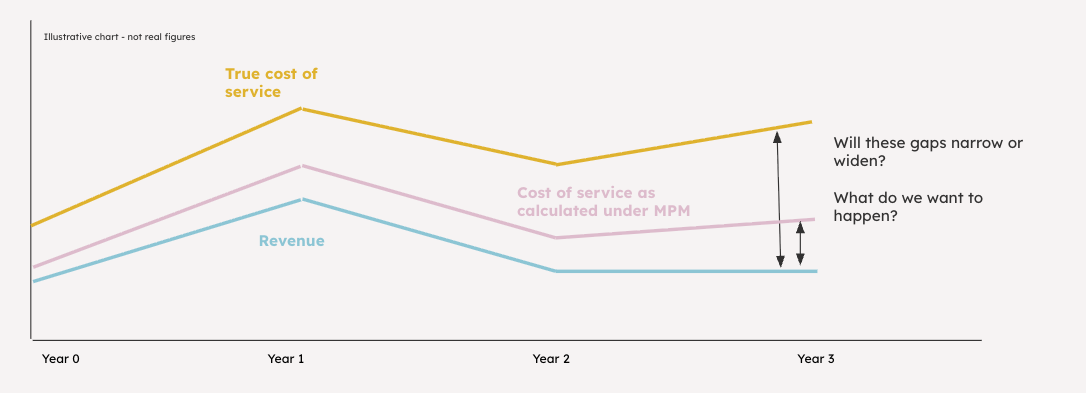
For fee-paying services, the guidance for UK public sector is in the Treasury’s Managing Public Money (MPM). Although this states that charges should recover full costs, in practice there is often a difference between the service cost calculation used to set fees and a true service cost calculation that accounts for everything used. It’s worth distinguishing these calculations and not insisting they are the same.
How visibility changes the service owner role
When the service owner has visibility of and responsibility for service costs then they start making genuine tradeoff decisions.
Should we reduce this system cost by changing this process? Is it more useful to have another data analyst or a user researcher? How quickly should we digitise this and reduce manual tasks?
Service owners move from ‘lobbying’ the organisation for resources that would help them, to making the necessary tradeoffs themselves.
Of course they also begin to have a much higher incentive to bear down on costs - both those incurred with external suppliers and costs for people and resources from inside the organisation.
Ultimately this can lead to a dramatic reshaping of responsibility for organisational costs and performance - centred on the services rather than individual functions.
In many organisations without visible service costs, functional leaders are effectively making siloed decisions on which services they think are most important and which expenditure they think is important to each of them. And they often do this under pressure from Finance teams for constantly smaller budgets.
A more rational approach is for the executive team to oversee the service portfolio and decide on the allocation of available expenditure across it. Service owners can then take a holistic view of which spend is going to be most useful within their available envelope.
This is a change for Finance teams too. They transition from a centralised role that often feels itself alone in ‘holding the line’ on costs, towards a position of helping to empower and coordinate service owners who are working on their behalf to grapple with outcome/cost tradeoffs on behalf of the organisation.
The power of forecasting
There’s one final benefit.
When service expenditure becomes clear, the natural next step is to try to forecast how it might change over time.
Do we expect costs to go up or down - and if so by how much? What are the factors driving the costs and what power do we have over them? If the service is fee-paying then do we expect fee income to change in a similar direction or deviate?
For the service owner, this opens up an important strategic space that might not have been available before. They can begin to think over a longer horizon about how their service might evolve, what capabilities they may need to build and so on.
For fee-paying services with dynamic demand, forecasting is essential for planning capacity (or being able to quickly increase it), fee levels and so on. This only makes sense when done for the whole service.